
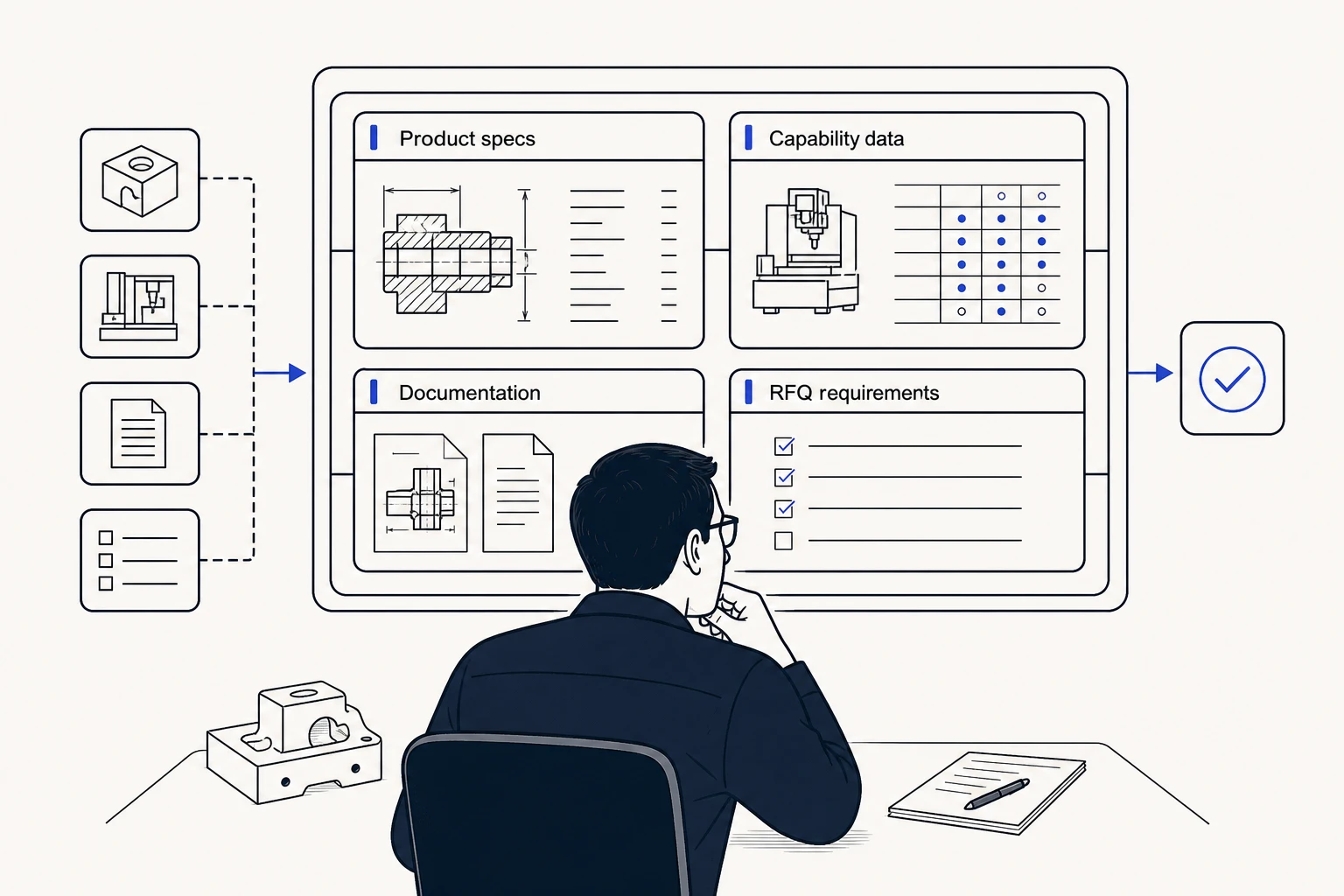
Most manufacturing websites make technical buyers do too much unpaid interpretation. The page says precision, quality, innovation, and experience. The buyer still has to work out materials, processes, tolerances, documentation, equipment boundaries, and whether an RFQ would waste everyone’s time.
That is why manufacturing website design needs stronger product and capability pages. The site should function as a pre-sales technical interface built around four connected layers: product, capability, resource, and qualification. Each layer answers a different buyer question, while the connections among them help someone evaluate fit without pretending the website can approve engineering, capacity, price, or supplier status.
Why do generic manufacturing service pages fail technical buyers?
Broad claims such as precision, quality, innovation, and experience can establish a tone. They rarely answer the harder question: can this manufacturer support the buyer’s particular product, process, material, operating condition, or documented standard?
One crowded “Capabilities” page usually makes that problem worse. It may mix equipment names, industries, process labels, quality language, product photos, and a generic contact form without explaining how the pieces relate. The buyer sees activity but still has to infer the boundaries.
TREW Marketing’s State of Marketing to Engineers research supports the directional point that engineers and technical buyers use digital resources and supplier content during work-related research. Its findings come from a surveyed audience, so they shouldn’t be treated as universal behavior or as proof of sales results. They do make one practical standard reasonable: a supplier page should offer substantive information before asking for a call.
Interest and qualification are different. A page may earn attention while leaving fit unresolved. Better architecture gives the buyer enough context to identify a plausible match, a clear mismatch, or the questions that still require a technical conversation.
What is the difference between a product page, a capability page, and a resource page?
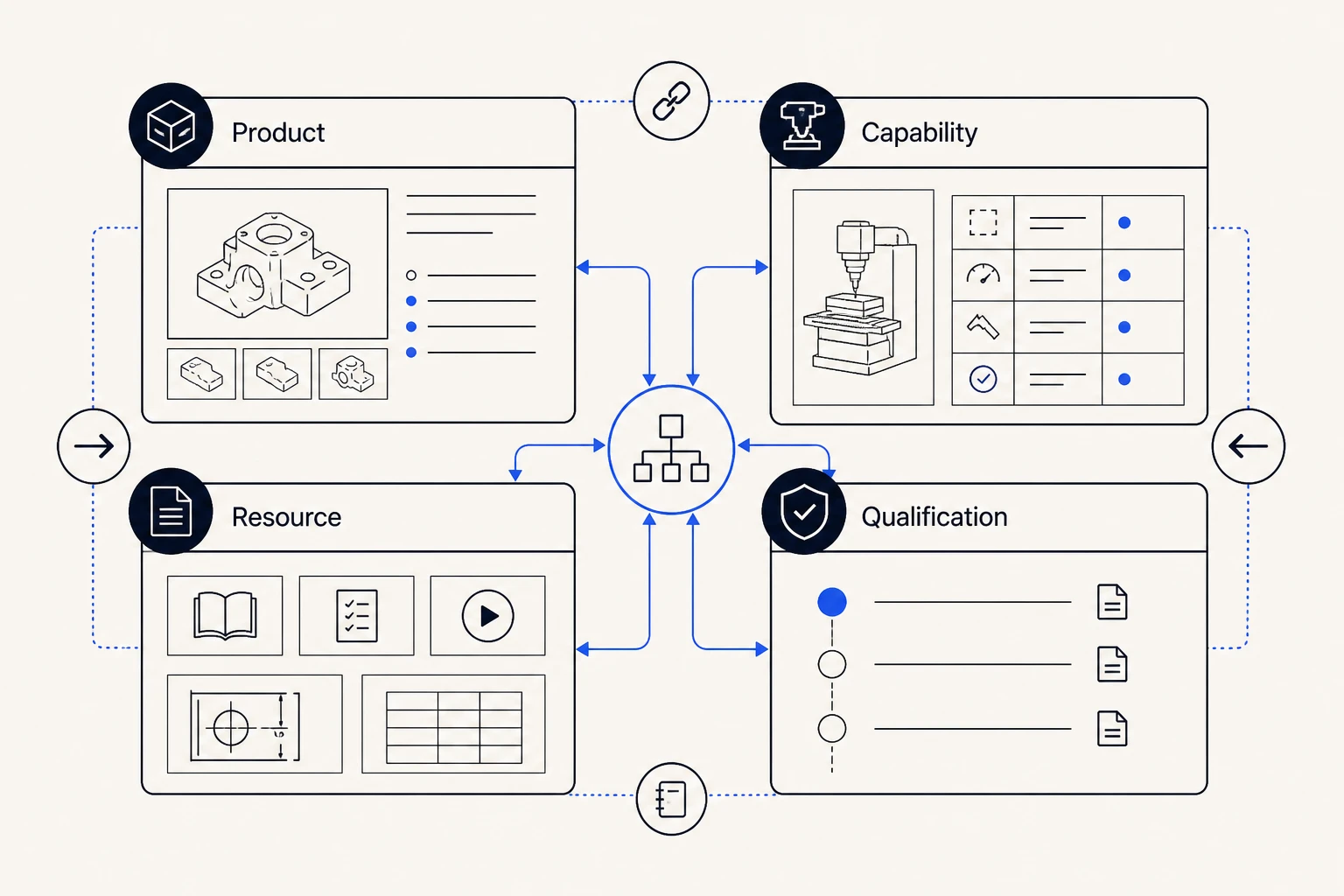
A useful architecture gives each page type a defined job:
- Product pages answer what is offered. They organize families, models, variants, applications, and the attributes that distinguish one option from another.
- Capability pages answer what can be made or performed, and under which conditions. They connect processes, materials, equipment, ranges, controls, and relevant limits.
- Resource pages support a decision. They provide data sheets, drawings, certificates, guides, FAQs, videos, or other evidence with enough context to interpret it.
- Qualification paths help the buyer prepare the next step. They explain which inputs may be needed for an RFQ and preserve the product or capability context behind the inquiry.
These jobs don’t require one universal URL structure. A manufacturer with a small, stable offering might use structured sections on fewer pages. A company with several product families and complex processes may need separate templates, comparison routes, and resource records. The right web design and development approach should reflect how buyers evaluate the actual offering, rather than forcing every manufacturer into the same sitemap.
Connections matter as much as page definitions. A product should point to the capabilities that make it possible. A capability should point to relevant products, applications, and evidence. A resource should return the reader to the decision it supports, not strand them in a document archive.
Could your current pages support a real fit decision? Get a Free Website Assessment. We can connect product, capability, and resource content into a clearer technical buyer journey.
What should a manufacturing product page help a buyer decide?
A product page should help someone identify the offering, understand where it may fit, and find the variables that need confirmation. The public details depend on the product family, market, buying stage, and confidentiality requirements. There is no responsible universal template.
Possible decision fields include:
- Identity and use: product name, family, intended applications, and meaningful distinctions among variants.
- Relevant attributes: materials, dimensions, ranges, finishes, performance conditions, compatible processes, or interface requirements.
- Standards and documentation: applicable standards, test information, data sheets, drawings, instructions, or declarations, when verified and properly scoped.
- Configuration boundaries: what is standard, what is configurable, what is quote-dependent, and what requires technical review.
- Next steps: related capabilities, supporting resources, questions to resolve, and an inquiry route that retains product context.
Not every detail belongs in a table. A comparison table can help when buyers need to scan consistent attributes across a family. Diagrams may clarify geometry or interfaces. Filters can help with a larger, genuinely structured catalog.
Careful UI and UX design can make those interactions easier to understand, but an elegant selector can’t repair vague or unapproved source data.
Separate established facts from configurable conditions. If material availability, dimensional range, performance, finishing, or documentation changes by configuration, say that plainly. “Contact us for details” shouldn’t replace every specification, yet the page also shouldn’t imply that a published range guarantees manufacturability, available capacity, lead time, or acceptance of a particular job.
For genuine product pages, Google’s documentation on product structured data explains how eligible product details can be made understandable to Google and may qualify for richer search presentation. That is a conditional enhancement. Many custom-manufacturing capabilities don’t behave like conventional retail products, and markup never substitutes for accurate visible content or guarantees a search appearance.
How should a capability page make technical fit easier to evaluate?
Start with the buyer’s real question: what can this supplier do, under what conditions, and with what evidence? A machine list answers only one slice. Equipment matters when it clarifies an actual process or working envelope, but names and model numbers alone leave the buyer to translate assets into feasibility.
A capability page may need to describe:
- Process: what operation is performed and where it sits within a broader production sequence.
- Materials and inputs: supported categories, relevant grades, forms, or buyer-supplied requirements, where disclosure is appropriate.
- Working envelope: dimensions, ranges, tolerances, finishes, or other bounded conditions that subject-matter owners have approved for public use.
- Production context: prototype, repeat production, assembly, secondary operations, inspection, packaging, or other relevant stages without promising current capacity.
- Quality evidence: documented controls, inspection methods, certifications, or standards with the applicable entity, facility, scope, and current status made clear.
- Limits and exclusions: known boundaries that help a buyer avoid a false assumption, subject to confidentiality and competitive sensitivity.
The correct fields vary sharply across machining, fabrication, components, materials, equipment, and other industrial categories. Publish what supports a responsible initial decision. Hold back proprietary process knowledge, sensitive thresholds, and details that could be misleading without engineering context.
The NIST Manufacturing Extension Partnership supplier-scouting program illustrates why understandable capability information matters in supplier matching: a stated supply need has to be connected with manufacturers that may be able to address it. NIST guidance supports a narrower practical connection for capability-page content and supplier evidence. Clear descriptions give matching and evaluation efforts better material than slogans alone.
Every public claim needs an owner who can distinguish demonstrated capability from aspiration. Marketing can shape the explanation, but engineering, quality, operations, or product leaders should approve the technical substance. A polished sentence cannot establish tolerance, certification, capacity, or feasibility.
Evidence should sit close to the claim it supports. If a page references a certification, test method, material class, inspection process, or example application, link or explain the relevant scope. That context helps a buyer understand what has actually been demonstrated and what still needs confirmation.
How can technical resources support evaluation without becoming a document dump?
A resource earns its place by answering a buyer question. A data sheet may clarify properties. A drawing may explain dimensions or interfaces. A certificate may document a defined status and scope.
A guide, FAQ, video, or case example may show how a product or capability applies under stated conditions.
A generic “Downloads” page strips away those relationships. File names such as brochure-final-2.pdf give no clue about audience, scope, or currency. Instead, attach resources to the relevant product or capability and provide a clear title, short description, owner, and revision or effective date when recency matters.
Critical decision information often deserves visible HTML as well as a download. A buyer shouldn’t have to open several PDFs to learn the basic material range, find a documented limitation, or understand whether a resource applies to the product on screen. Downloads remain useful for portable technical records, drawings, printable data, and controlled documents.
Google’s guidance on helpful, reliable, people-first content asks whether material provides substantial, complete information for its intended audience and helps that audience achieve a goal. For a manufacturing page, that means serving the technical decision rather than padding a page for search. The guidance doesn’t define qualification criteria or guarantee rankings, traffic, inquiries, or sales.
Resource governance matters too. Replace or retire stale files through a controlled process, identify superseded material, and preserve a route back to the current product or capability page. A perfectly organized library can still mislead if nobody owns its technical accuracy.
What turns technical education into an RFQ-ready path?
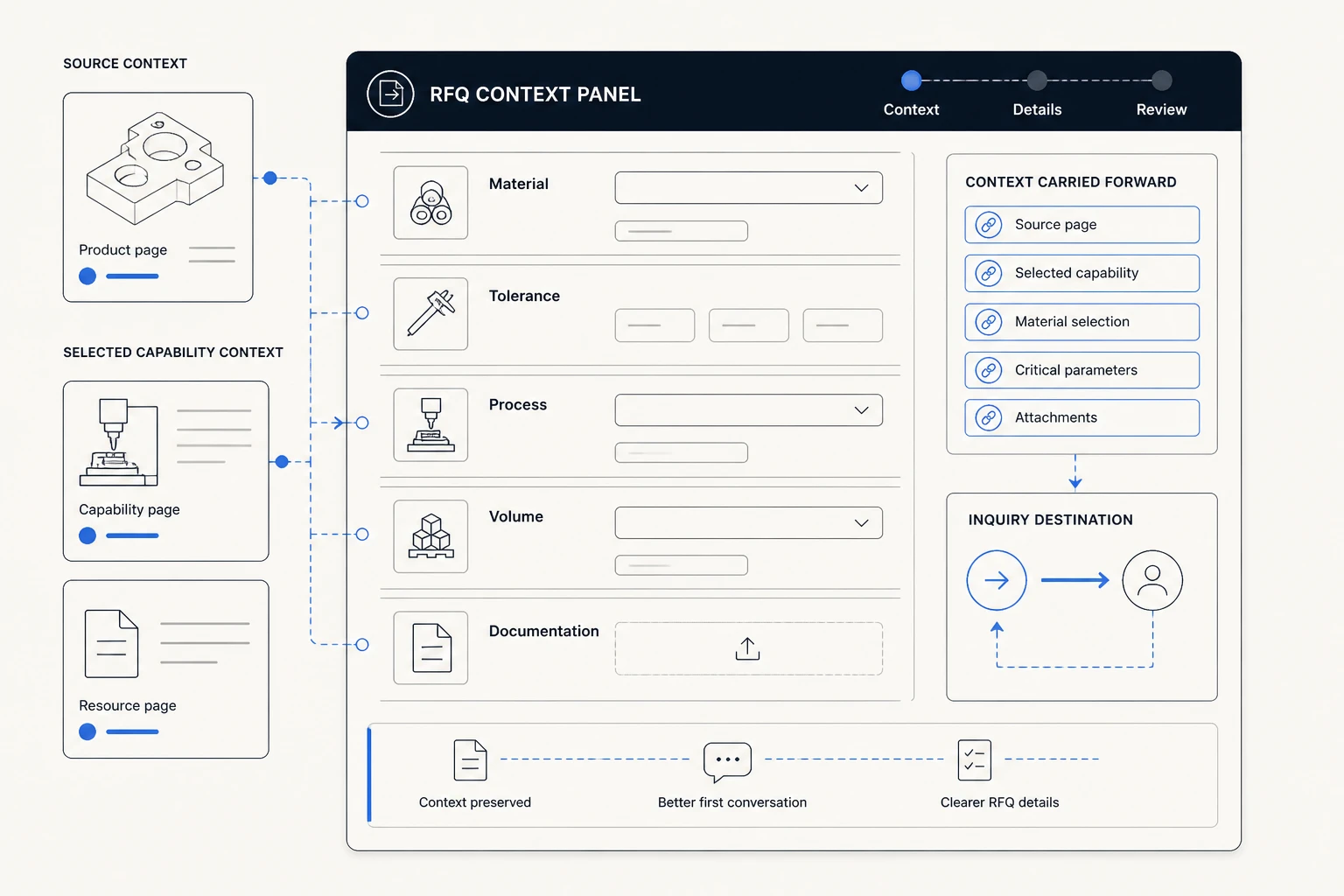
The best next step depends on what the site has helped the buyer learn. A product page might lead into a configuration-specific question. A capability page might invite a drawing review or a discussion about process fit. In either case, the inquiry route should carry forward the source page, selected family, relevant capability, and resource context where appropriate.
The page can also help the buyer assemble useful RFQ inputs. Depending on the manufacturing category, those might include:
- application or operating context
- product, part, or capability of interest
- material and finish requirements
- dimensions, tolerances, and applicable standards
- quantity, production stage, and target timing
- drawings, models, specifications, or reference files
- known constraints and open technical questions
This is guidance, not a mandatory form for every visitor. Requiring details that a buyer cannot yet know creates a new barrier. Hiding every useful prompt behind one empty message box discards an opportunity to prepare the conversation.
Good forms make uncertainty acceptable. They distinguish required from optional inputs, explain supported file expectations, and provide a path for someone who needs early guidance. They also avoid implying that an upload is secure for every sensitive document without the relevant controls and policies in place.
RFQ readiness has a precise limit. The website may reduce avoidable ambiguity and help sales receive a more intelligible starting point. It does not perform manufacturability review, confirm capacity, approve pricing, qualify a supplier, accept a contract, or guarantee a commercial outcome.
Does your RFQ path preserve the technical context a buyer just assembled? Get a Free Website Assessment. We can shape page architecture and inquiry routes around better-prepared first conversations.
How should manufacturers govern specifications and claims after launch?
Launch freezes nothing. Equipment changes, products evolve, materials shift, documents expire, certifications change status, and a once-accurate sentence can become incomplete. A technical-content system needs named ownership and an update path that fits those events.
Assign responsibility by claim type. Product teams may own family definitions and configurations. Engineering or operations may own processes, ranges, and exclusions. Quality leaders may own standards, certificates, and inspection language.
Sales can surface recurring buyer questions, while marketing and website content writing specialists turn approved facts into clear public explanations.
A practical governance record can include:
- the source of truth for each critical field or document
- the subject-matter owner and approver
- the last review date and approval record
- the event that should trigger an earlier review
- the public page or resource using the claim
- the action for disputed, expired, or superseded content
Cadence and events solve different problems. A scheduled review catches quiet drift. Event-driven updates respond to a new machine, discontinued material, changed product, revised standard, certificate update, or altered process before the next scheduled check.
Some manufacturers can manage this with disciplined page templates and clear responsibilities. Others may need custom CMS development to structure shared specifications, reusable capability relationships, document status, and approvals. A CMS can enforce required fields and workflow steps, but it cannot decide whether a technical claim is true.
Keep an escalation route for disagreement. If marketing, sales, and a subject-matter owner interpret a claim differently, pause or narrow the public statement until the responsible team resolves it. Speed is less valuable than publishing a boundary the organization can defend.
Can the website help both sides reach a better first conversation?
Yes, when it gives every layer a clear assignment. Product content identifies what is offered. Capability content explains what may be possible and under which documented conditions. Resources provide decision-specific evidence.
Qualification paths help a buyer bring the right context into an RFQ or early technical discussion.
Specificity serves both sides. It can help a plausible buyer identify a relevant route, while giving someone outside the stated range enough information to pause or ask a sharper question. That responsible self-selection is valuable even though it doesn’t equal supplier approval, a valid quote, engineering acceptance, or a sale.
Treat manufacturing website design as an interface between public technical knowledge and human expertise. Show what can be shown accurately. Mark variables and limits. Connect evidence to claims, then keep those claims governed as the business changes.
The result should be a better starting point, not a digital promise that outruns the operation.
Can a buyer understand enough to take the next responsible step? Get a Free Website Assessment. We can help organize technical content around products, capabilities, resources, and RFQ preparation.